The Tokenmaxxing Trap: More Agents, Same Chair
Meta built a leaderboard. They called it "Claudeonomics" and ranked 85,000 employees by how many AI tokens they burned in a month. The top user hit 281 billion tokens in 30 days. People got titles like "Token Legend." It lasted a few weeks before the backlash killed it.
But the instinct behind it didn't go away. Across tech, the logic runs the same: more tokens consumed equals more AI leverage equals more output. Tokenmaxxing — the practice of maximizing how much AI you run — has become the new hustle metric. The new "hours in the office." The new "lines of code committed."
And like those metrics before it, it measures the wrong thing. Because the people burning the most tokens are often the same people still stuck in their chair, watching.
You're supposed to walk away
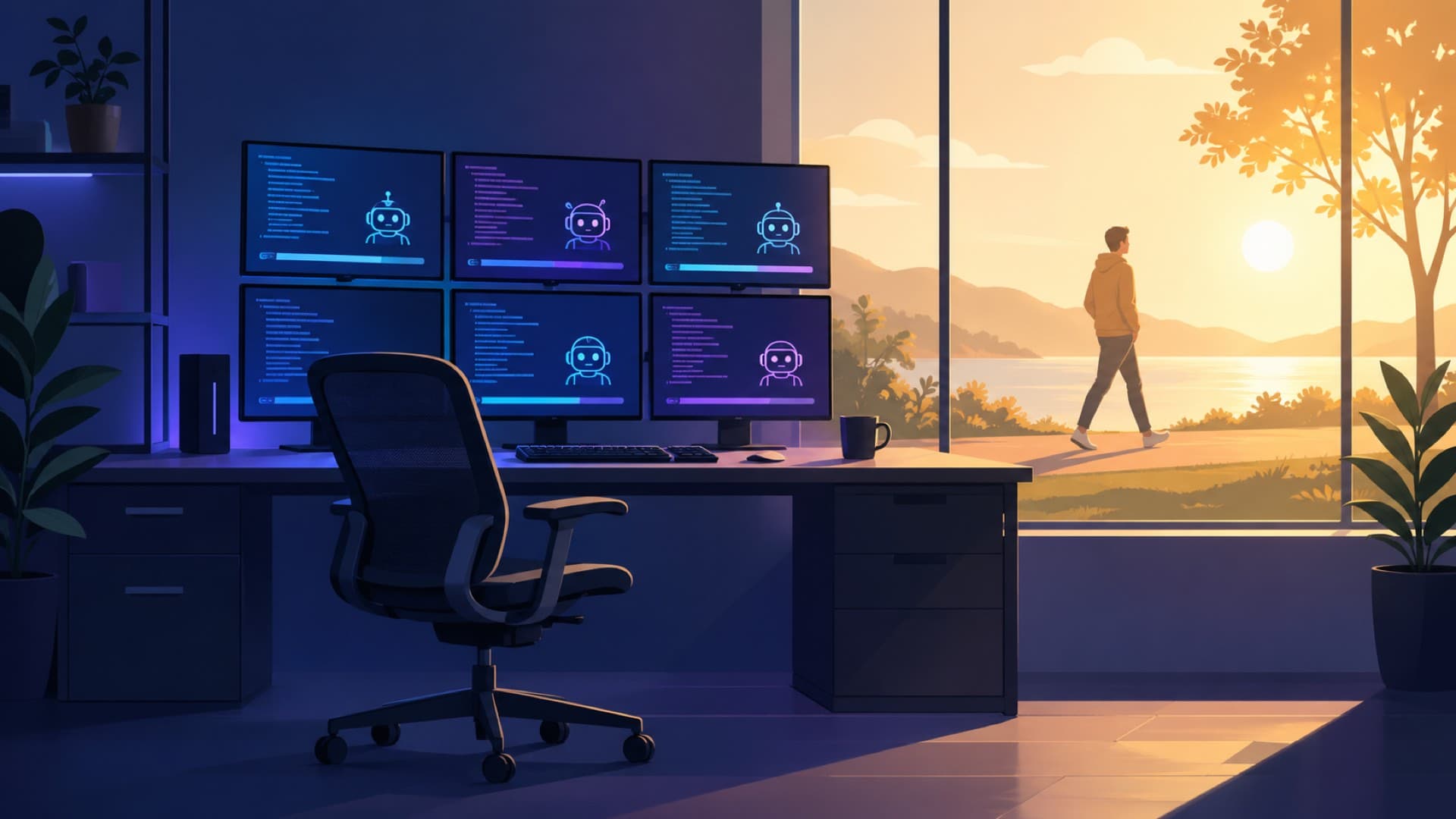
Here's the promise of tokenmaxxing: you fire up a fleet of AI agents — a coding agent refactoring a module, a research agent crawling docs, a monitoring agent watching your infra, maybe a trading bot — and then you go live your life. Go for a run. Have lunch with a friend. Take the afternoon off. The agents are working. That's the whole point.
But nobody actually does this. Instead, you're glued to the screen. Tabbing between terminals. Refreshing dashboards. Checking if the coding agent is still on track or if it started going in circles twenty minutes ago. You're burning tokens at an impressive rate, but you're also burning your afternoon watching the tokens burn.
This is tokenmaxxing's dirty secret: most people running AI agents are still babysitting them. Not because the agents are bad, but because there's no reliable way to know when an agent gets stuck.
Agents get stuck. That's normal.
Every agent hits walls. The coding agent encounters a merge conflict it can't resolve. The research agent finds contradictory sources and needs a judgment call. The monitoring agent sees a pattern that doesn't match any known playbook. The trading bot's exchange API starts returning errors.
These aren't failures. They're the moments where autonomy correctly hands back to a human. The agent recognized it was stuck and tried to tell you.
But "tried to tell you" usually means a message in a terminal you're not looking at. Or a Slack notification buried under forty others. Or an email you'll see tonight. The agent did the right thing. The message just didn't land.
So what do you do? You stay at your desk. You keep watching. Because you know that if you walk away, you'll come back to find the agent spun its wheels for two hours on something you could have unblocked in thirty seconds. You've seen it happen. Maybe today.
The screen is the bottleneck
Think about what's actually keeping you in your chair. It's not that agents need constant supervision. Most of the time, they're fine. It's that when they need you — and they will — the only way you'll know is if you happen to be looking.
One agent in one terminal — you'll catch it. Three agents across two tools — you'll probably notice within an hour. But the moment you leave the room, the feedback loop breaks. The agent is stuck, you're at the grocery store, and neither of you knows how to reach the other.
This scales in the wrong direction. The more agents you run, the more likely one of them needs you right now. The more likely one of them needs you, the harder it is to walk away. The harder it is to walk away, the less value you're actually getting from all those tokens.
You wanted leverage. You got a second job: watching AI work.
What if agents could call you?
The fix isn't to watch more carefully. That defeats the entire purpose. The fix is simple: give your agents a way to reach you that works even when you're away from the screen.
from agentping import AgentPing

client = AgentPing(api_key="your-key")

# Agent hit something it can't resolve alone
client.send_alert(
    message="Refactor agent stuck: circular dependency in auth module, needs human decision",
    severity="normal",
)

# Something is actively going wrong
client.send_alert(
    message="Production deploy agent failed 3 retries, rollback needs approval",
    severity="critical",
)
A normal alert calls your phone during waking hours. A critical alert calls regardless — it bypasses quiet hours and retries until you pick up. You press 0 to acknowledge, 1 to snooze five minutes, or enter a number followed by # for a custom snooze.
The mechanism matters less than what it enables: you can leave. The agent will call you if it's stuck. If your phone doesn't ring, everything is fine.
The freedom to walk away
Here's what actually changes.
You start a refactor agent on a large module. Normally you'd sit there watching it, ready to course-correct. Instead, you add a three-line escalation hook and go for a walk. Forty minutes later, your phone rings: the agent hit a circular dependency and needs you to decide which module owns the shared type. You tell it. You keep walking. It keeps working.
You leave a trading bot running overnight. Normally you'd set a 4 AM alarm to check on it. Instead, you sleep. If the exchange API goes down, you'll get a call. If it doesn't ring, the bot is fine. You wake up rested, check the dashboard over coffee, and see it handled the night without you.
You spin up five agents on a Friday afternoon — data migration, test generation, doc updates, dependency audit, and a monitoring sweep. Normally you'd babysit through the weekend. Instead, you go to a barbecue. Your phone is in your pocket. If any of them need you, they'll call. None of them do. Monday morning, five tasks are done.
That's the real promise of tokenmaxxing. Not "burn more tokens while staring at your screen harder." It's "burn tokens while you're somewhere else, living your life, because the agents will find you if they need you."
Trust is the real multiplier
The constraint on how many agents you run isn't compute or cost. It's trust. You don't spin up ten agents and leave the house because you don't trust ten agents to run without you. Not because they're unreliable — because if one of them gets stuck, you won't know until it's too late.
A reliable escalation path changes the math. You give agents more autonomy because the safety net is there. You run more of them because you're not the bottleneck anymore. You actually get the leverage that tokenmaxxing promises — not by watching harder, but by being reachable.
That's the difference between the tokenmaxxing trap and tokenmaxxing that actually works. The trap is more agents, same chair. The escape is more agents, empty chair — because they'll call you if they need you.
Getting started
- Sign up for a free account and verify your phone number.
- Install the AgentPing SDK — Python or TypeScript, a few lines.
- Wire it into the agents you're already running. Start with the one you trust least.
The free plan includes 10 escalated alerts per month. That's probably enough to see whether having a real escalation path changes how often you feel comfortable leaving your desk.
Your agents are already burning tokens. Make sure they can reach you when they're stuck — so you don't have to sit there watching.